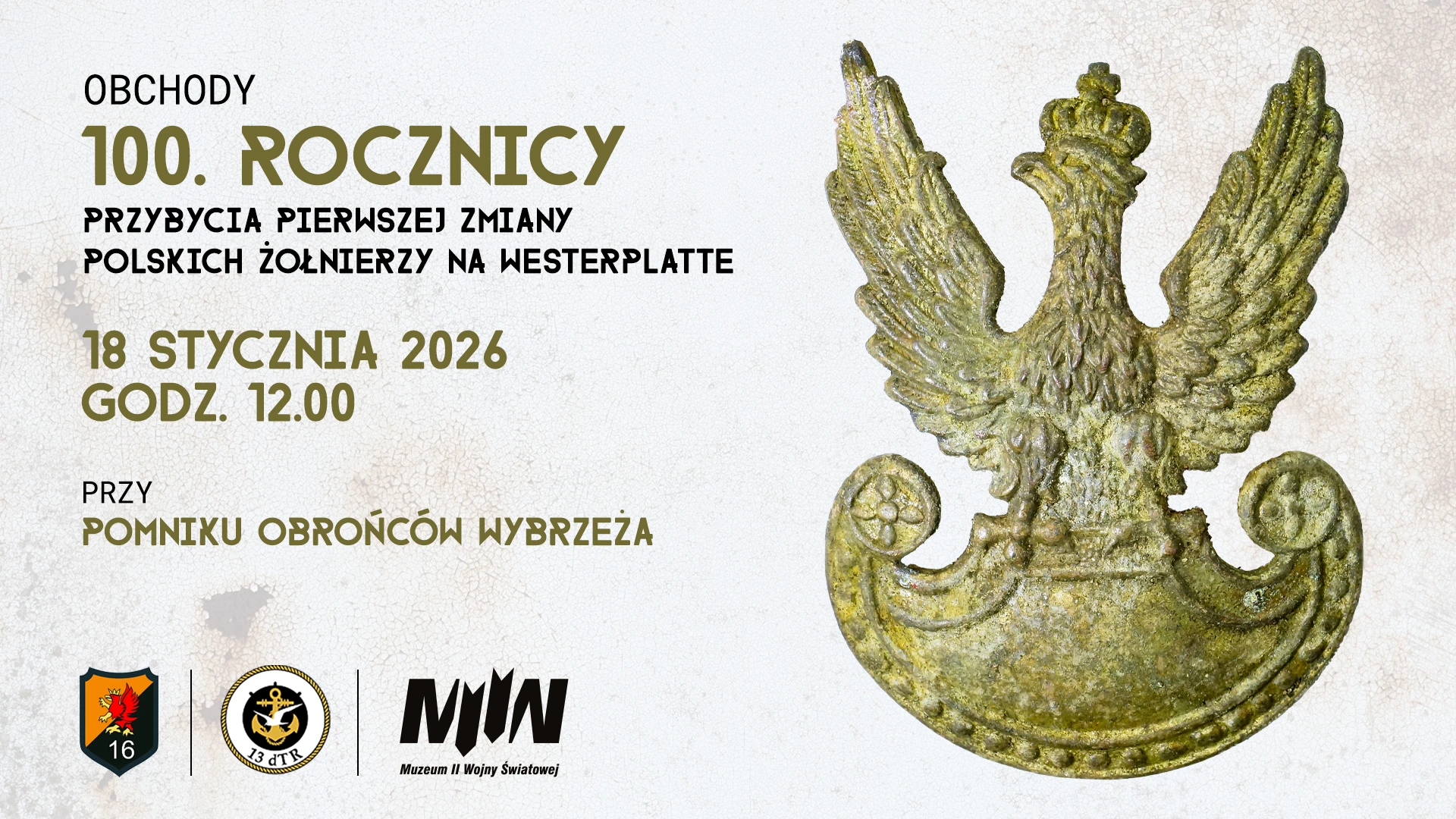
18 January 2026 will mark exactly one hundred years since the first Polish soldiers took up their posts at Westerplatte. To mark this occasion, the Museum of the Second World War in Gdańsk and the 16th Żuławy Logistics Regiment of the Defenders of Westerplatte in Elbląg invite you to commemorate this event. The ceremony will combine military protocol with a living history lesson.
Between 1926 and 1939, the Polish Military Transit Depot operated at Westerplatte in the Free City of Gdańsk. It housed ammunition depots guarded by Polish soldiers.
On 18 January 1926, at 2 p.m., the first guard unit, consisting of one officer, four non-commissioned officers and sixteen privates, arrived at Westerplatte on board the minesweeper ORP Mewa. The unit was commanded by Lieutenant Stefan Konieczny, and the soldiers were provided by the 4th Infantry Division. This was the symbolic and actual beginning of the Polish military presence on the Baltic Sea, which lasted uninterrupted until the heroic defence of Westerplatte in September 1939.
To commemorate this event, the 16th Żuławy Logistics Regiment from Elbląg, the 13th Minesweeper Squadron and the Museum of the Second World War in Gdańsk have jointly planned celebrations on the peninsula. A sub-unit of soldiers from the 16th Żuławy Logistics Regiment in period uniforms will arrive on board a ship of the 13th Minesweeper Squadron, recreating the manoeuvre of their predecessors from a hundred years ago.
Ceremonial roll call with military escort
The event will be inaugurated by a ceremonial roll call with the participation of the military honour guard of the 16th Żuławy Logistics Regiment of the Defenders of Westerplatte, which will begin at 12:00 noon at the Monument to the Defenders of the Coast. This unit inherits and proudly cultivates the traditions of the Military Transit Depot, forming a living bridge between history and the present day.
“This is not only a historical anniversary, but also a celebration of the Polish uniform and Poland’s presence on the Baltic Sea,” emphasise the organisers. “We want these celebrations to be a living history lesson that will help people understand how important this small outpost at Westerplatte was for the Second Polish Republic.”
Then, the delegations will march solemnly to the Polish Army Cemetery at Westerplatte, where they will lay flowers and pay tribute to those who died defending the peninsula in September 1939.
The soldiers of the 16th Żuławy Logistics Regiment, while cherishing traditions, are also dynamically entering the 21st century. They focus on modernity and professionalism. They use modern equipment and constantly improve their qualifications, performing a key service by guarding the eastern border of Poland, NATO and the European Union. They also provide assistance to those in need, for example, by removing the effects of floods.
Educational stands and presentation of a historic cannon from Westerplatte
On this day, the Museum of the Second World War will set up a special educational stand, located in a tent in the car park near the cemetery, open from 10:00 a.m. to around 2:00 p.m. Visitors will be able to take part in interesting activities prepared by museum staff.
The Archaeology Department will present artefacts that were excavated during excavation work at Westerplatte. Archaeologists will also talk about the twelve completed research seasons.
The Collections and Digitisation Department will present a copy of a so-called putiłówka – a field cannon that was part of the equipment of the Military Transit Depot. Employees of the Museum of the Second Polish Republic will talk about how cannons of this type were used by soldiers and about the history of the one located at Westerplatte in 1939.
The Education Department will present the history of the Military Transit Depot using dioramas depicting former military facilities at Westerplatte.
Employees of the Westerplatte Museum, a branch of the MIIWŚ, will talk about the ongoing investment project involving the construction of the Westerplatte Museum building, which is scheduled for completion in 2030.
On that day, it will also be possible to purchase a ticket to the exhibition ‘Memory Written in the Earth. Archaeology of Westerplatte’ presented in the former power plant of the Military Transit Depot for 1 PLN!
Those interested will also be able to visit the exhibition with archaeologists – curators of the exhibition. Guided tours will start at 10:30 a.m., 12:30 p.m., 1:30 p.m. and 2:30 p.m. (registration is required via the Museum's website; groups will be limited to a maximum of 20 people, and each tour will last approximately one hour).
